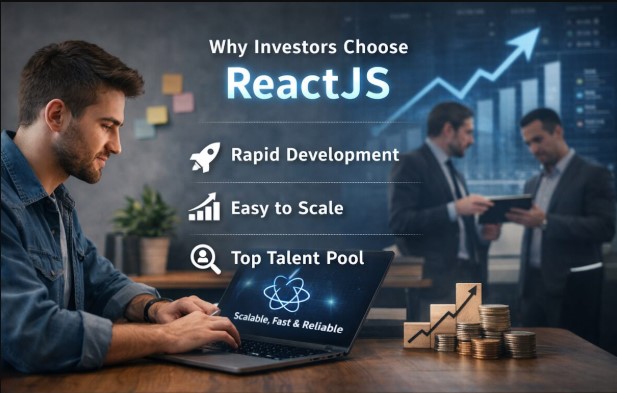

When investors look at a startup, they don’t just see an idea. They see risk, runway, product velocity, and long-term potential. They ask sharp questions. How fast can this team ship? Can the product scale? Will future upgrades be painful or smooth? How easy is it to hire developers?
And somewhere in that conversation, the frontend framework quietly matters.
Over the past decade, ReactJS has become a steady favorite. Not hype. Not trend chasing. Just consistent trust.
Let’s break down why ReactJS keeps showing up in pitch decks, tech stacks, and investor checklists.
Fast Product Development Means Faster Validation
Investors care about time. How quickly can you test your idea? How fast can you release version two? If the first attempt misses the mark, can you pivot without rebuilding everything?
ReactJS makes quick iterations possible. Its component-based structure allows teams to build reusable pieces. A header built once can be reused across pages. A dashboard widget can be adjusted without breaking other sections.
That translates into speed.
Speed means faster validation. Faster validation means earlier traction. And early traction gets investor attention.
If you’re building a startup, you don’t have years. You have months. Sometimes weeks.
React fits that reality.
Scalability Without Rewriting the Product
Here’s something investors hate: technical debt that forces a complete rebuild.
You launch with 5,000 users. Things work fine. Then you hit 100,000 users and everything slows down. The team panics. Performance drops. Users complain. Revenue dips.
ReactJS handles growth well because of its virtual DOM and efficient rendering. Updates happen smartly, not blindly. The UI stays responsive even when the app becomes complex.
More importantly, React scales in structure. Large applications can be broken into manageable components. Teams can work in parallel without stepping on each other’s toes.
That gives investors confidence. They know the product won’t collapse under its own weight.
Strong Talent Availability Reduces Hiring Risk
Let’s be real. A great idea fails if the team can’t execute.
Investors check hiring feasibility. If a startup uses a rare or outdated technology, finding skilled developers becomes expensive and slow.
ReactJS has one of the largest developer communities worldwide. From North America to Europe to Asia, React talent is widely available. That reduces hiring risk.
For companies looking to extend their teams, many choose to work with providers offering ReactJS Development Services in India. India has a deep pool of experienced React engineers who work across time zones and deliver high-quality builds at competitive costs.
Lower hiring friction equals smoother growth.
And investors notice that.
Backed by Big Names
ReactJS was created by Facebook and is actively maintained by Meta and a global community of contributors. That history matters.
When investors evaluate technology choices, they look for stability. Is the framework still supported? Are updates consistent? Is there a roadmap?
React checks those boxes.
Major companies like Netflix, Airbnb, Instagram, and Uber rely on React for their frontend applications. That’s not random. Large-scale companies do not gamble on unstable technology.
This track record reduces perceived risk.
And reduced risk increases funding confidence.
Strong Ecosystem Around React
React itself focuses on building user interfaces. Around it, there’s a massive ecosystem.
Routing libraries. State management tools. Testing frameworks. UI component libraries. Everything you need to build a complete product.
Need server-side rendering? Next.js works well with React.
Need mobile apps? React Native extends the same principles.
Need progressive web apps? React supports that too.
This flexibility allows startups to expand without switching technologies.
One code philosophy. Multiple platforms.
From an investor’s viewpoint, that’s cost control. That’s future proofing.
Cleaner Codebase Means Easier Maintenance
Maintenance is where money quietly drains.
Messy code leads to bugs. Bugs lead to churn. Churn leads to revenue loss.
React encourages structured development through reusable components and predictable data flow. While no framework guarantees perfect code, React supports maintainable architecture when used correctly.
That matters long term.
When investors fund a company, they are thinking years ahead. They want products that can adapt without constant firefighting.
React supports that steady growth.
Better User Experience Drives Retention
Retention is king.
You can spend millions acquiring users. If your interface feels slow or clunky, they leave.
React’s fast rendering and smooth interactions help create responsive interfaces. Users click, scroll, type, and see results quickly. That responsiveness shapes perception.
If your product feels polished, users trust it more.
Investors look closely at retention metrics. Good frontend performance influences those numbers more than many founders realize.
Easy to Extend and Upgrade
Products evolve. Features expand. Markets shift.
React allows gradual updates. You can refactor parts of the application without tearing everything down. Want to introduce a new feature? Build a component and plug it in.
No dramatic rebuild required.
This flexibility lowers long-term development costs. Investors prefer predictable costs.
Surprises scare them.
Global Outsourcing Made Simple
Many startups operate lean. Instead of hiring a full in-house team, they extend capabilities through external partners.
If you plan to Hire React Developers, you’ll find it easier compared to niche frameworks. The global demand has created a strong supply of talent.
Companies offering ReactJS Development Services in India have built structured teams, processes, and quality standards around React projects. For startups in the US, this means round-the-clock development cycles and controlled budgets.
Investors see that as smart resource management.
Community Support Means Faster Problem Solving
Every development team hits roadblocks.
When using React, chances are someone has faced the same issue before. Stack Overflow threads, GitHub discussions, open-source examples. The support network is vast.
Faster problem solving leads to fewer delays.
Delays cost money.
Money is runway.
Runway is survival.
Investors connect those dots quickly.
Flexible Architecture for Different Business Models
React works for SaaS platforms, marketplaces, fintech dashboards, healthcare portals, and eCommerce stores.
It doesn’t force a rigid structure. Teams can design the architecture based on business needs.
That flexibility allows founders to pivot when needed. If the original target market shifts, React does not become a bottleneck.
And let’s be honest. Many startups pivot.
Investors know this. They appreciate tech stacks that don’t resist change.
Strong Developer Preference
Here’s something subtle but powerful.
Many developers enjoy working with React. The learning curve is manageable. The documentation is clear. The component-based thinking feels natural after some time.
Happy developers stay longer.
Lower turnover reduces knowledge loss.
Stable teams build better products.
Investors want stable teams.
Testing and Reliability
React supports testing through tools like Jest and React Testing Library. Teams can test components independently. Bugs can be caught early.
Reliable products build user trust. Trust drives revenue.
Revenue sustains growth.
Investors follow revenue closely.
Works Well With Modern APIs
Modern applications rely on APIs. Payment gateways. Analytics tools. CRM systems. Marketing automation platforms.
React integrates smoothly with backend APIs. Whether the backend is built with Node.js, Python, Ruby, or .NET, React connects easily through REST or GraphQL.
That flexibility prevents vendor lock-in.
Investors dislike lock-in.
Performance Improvements Over Time
React continues to improve performance through updates and best practices. Features like lazy loading and code splitting allow apps to load only what users need.
That reduces initial load time.
Faster load times reduce bounce rates.
Lower bounce rates increase engagement.
Simple chain reaction.
A Smart Choice That Signals Maturity
When investors review technical architecture, they look for thoughtful decisions.
Choosing React shows the team is not chasing random trends. It shows they value scalability, maintainability, and access to talent.
It signals maturity.
And maturity builds trust.
What This Means for Founders
If you’re pitching investors, your tech stack won’t be the only factor. But it plays a role.
Ask yourself:
Can your product scale without a rebuild?
Can you hire developers quickly if funding arrives?
Can you expand features without chaos?
Can you control long-term development costs?
ReactJS helps answer those questions confidently.
If you are planning your next build or looking to upgrade your frontend, exploring ReactJS Development Services in India can help you access skilled engineers while maintaining budget control.
And if you want to quickly scale your internal team, you can Hire React Developers who already understand complex product requirements and startup pressure.
Smart technology choices create breathing room.
Breathing room allows growth.
The Bottom Line That Investors Care About
Investors don’t fall in love with frameworks.
They fall in love with predictable growth, manageable risk, and scalable products.
ReactJS supports all three.
It helps teams move fast.
It supports long-term scaling.
It reduces hiring risk.
It keeps maintenance manageable.
It adapts when markets shift.
That’s why ReactJS continues to be a frontend framework investors trust.
Not because it’s trendy.
Because it works.
And when you’re building something that needs funding, trust matters.